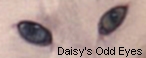
 Daisy also had odd eyes. One eye was blue, and the other green. This really developed after she was
about a year old, and everyone thought that this was the niftiest thing. It wasn't until I was older
that I found out that this was not normal.
Daisy also had odd eyes. One eye was blue, and the other green. This really developed after she was
about a year old, and everyone thought that this was the niftiest thing. It wasn't until I was older
that I found out that this was not normal.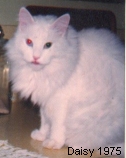 Following Shanty's passing, my family adopted a large white long-haired sheepdog puppy from the
San Mateo County animal shelter who went by the name of Rodriques (aka "Roddy"). At the same time, their search for
an identical looking cat resulted in meeting (through a classified ad in the Stanford Daily) a family of long-haired white
cats living on the Stanford campus with the family of Dr. Burton Richter [Note: At the time, Dr. Richter was Director
of the Stanford Linear Accelerator Center and years later received the Nobel Prize.] As she playfully romped with her
mother and siblings in the tall green grass under a palm tree, it was learned that Daisy was the smallest in a
litter of six kittens living in the Richter household. Daisy, believed to be a female for the first six months
of her life, joined the Larson household in their home in Menlo Park. She was named for the Shasta Daisy, a
prominent flower in the Northern California mountain regions frequented by my family. During the period when
Daisy first lived with us, it was decided to adopt a second cat as a companion for Daisy and Roddy. Unfortunately,
Roddy the sheepdog fell into a deep illness almost immediately thereafter and subsequently died after living with
us for only a month or so. At that time, through an classified ad in the Palo Alto Times, we adopted
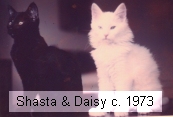
Shasta and joined Daisy in our household in Menlo Park. They fast became inseparable
friends with Daisy in their several residences in and about Menlo Park. They used "play fierce" as we called it,
an act of chasing each other all over the house. Sometimes the fights were just chases, sometimes they were
quite brutal, but never drew blood after the first few years. The pattern was always the same. Daisy would
get "the kitty crazies," and start the chase. It would end with a fight, and Daisy always, always lost. When
I got older, I would say, "Why do you do this?" and Daisy's response was always something like, "It's fun!"
Following Shanty's passing, my family adopted a large white long-haired sheepdog puppy from the
San Mateo County animal shelter who went by the name of Rodriques (aka "Roddy"). At the same time, their search for
an identical looking cat resulted in meeting (through a classified ad in the Stanford Daily) a family of long-haired white
cats living on the Stanford campus with the family of Dr. Burton Richter [Note: At the time, Dr. Richter was Director
of the Stanford Linear Accelerator Center and years later received the Nobel Prize.] As she playfully romped with her
mother and siblings in the tall green grass under a palm tree, it was learned that Daisy was the smallest in a
litter of six kittens living in the Richter household. Daisy, believed to be a female for the first six months
of her life, joined the Larson household in their home in Menlo Park. She was named for the Shasta Daisy, a
prominent flower in the Northern California mountain regions frequented by my family. During the period when
Daisy first lived with us, it was decided to adopt a second cat as a companion for Daisy and Roddy. Unfortunately,
Roddy the sheepdog fell into a deep illness almost immediately thereafter and subsequently died after living with
us for only a month or so. At that time, through an classified ad in the Palo Alto Times, we adopted
Shasta and joined Daisy in our household in Menlo Park. They fast became inseparable
friends with Daisy in their several residences in and about Menlo Park. They used "play fierce" as we called it,
an act of chasing each other all over the house. Sometimes the fights were just chases, sometimes they were
quite brutal, but never drew blood after the first few years. The pattern was always the same. Daisy would
get "the kitty crazies," and start the chase. It would end with a fight, and Daisy always, always lost. When
I got older, I would say, "Why do you do this?" and Daisy's response was always something like, "It's fun!"During her getting a routine series of shots in 1973, it was learned that she was actually a he, and she was subsequently neutered. We blame this on her very long, white hair. But the name "Daisy" had such a feminine name, we kept calling her a she. This was very confusing growing up, and I still to this day see Daisy as a she in verbal and written tongue. What made it worse, is our "male" cast Shasta went into heat that Christmas. So now he was a she, but Shasta would always be a she after that.
Daisy also had odd eyes. One eye was blue, and the other green. This really developed after she was
about a year old, and everyone thought that this was the niftiest thing. It wasn't until I was older
that I found out that this was not normal.
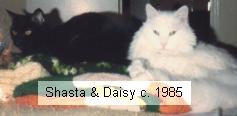
Daisy and Shasta: When the Larsons relocated to the Washington, DC area in the Spring of 1974, Daisy and Shasta flew together in a single carrier in the cargo hold of a United jet from San Francisco to Washington Dulles airport. They lived and played together in a hotel and temporary apartments for two months until our family moved into a home in McLean, VA. They aged gracefully, with Daisy growing to a large 16-pound roly-poly fun-loving cat.
 While growing up, Daisy and Shasta left me alone for the most part, but around age 12, Daisy decided that
I wasn't so bad, and would sleep with me a lot, usually by my feet. During this time, my depression was
starting to become a daily event, and Daisy could sense I was sick. While I was spending endless hours
staring at the ceiling, or under the bed, Daisy would be there. We talked to each other a lot, and it was
with her that I started to understand the cat language. I learned the subtleties of cat body language,
and how to interact with cats on their level. Now, before you think, "Oh, man... schitzo," it
wasn't like Daisy would say, "Grig, dear boy, would be so kind as to fetch me the morning Post?" or we'd
discuss Neitchze over coffee into the twilight. She would listen. I needed someone to tell all my thoughts
to, and her response was always enlightening. And what was her response? It was love. It is what I craved
so deeply. I was her companion. In my whole life, Daisy was the only sane person in my household, and she
witnessed my suicide attempts with the same concerned look. Daisy was my loving parent when I didn't have
any human ones.
While growing up, Daisy and Shasta left me alone for the most part, but around age 12, Daisy decided that
I wasn't so bad, and would sleep with me a lot, usually by my feet. During this time, my depression was
starting to become a daily event, and Daisy could sense I was sick. While I was spending endless hours
staring at the ceiling, or under the bed, Daisy would be there. We talked to each other a lot, and it was
with her that I started to understand the cat language. I learned the subtleties of cat body language,
and how to interact with cats on their level. Now, before you think, "Oh, man... schitzo," it
wasn't like Daisy would say, "Grig, dear boy, would be so kind as to fetch me the morning Post?" or we'd
discuss Neitchze over coffee into the twilight. She would listen. I needed someone to tell all my thoughts
to, and her response was always enlightening. And what was her response? It was love. It is what I craved
so deeply. I was her companion. In my whole life, Daisy was the only sane person in my household, and she
witnessed my suicide attempts with the same concerned look. Daisy was my loving parent when I didn't have
any human ones.
 Daisy grew progressively ill during 1986, suffering from kidney and epilepsy problems, and passed away at the age of
13 in October 23rd of 1986, when she was put to sleep at the McLean Vet Hospital. It was a hard decision for my mother
and I to make, but Daisy let us knew it was time. It was in her eyes I saw the future, and knew what was coming. Her
death was signaling the end of an era for me. With Daisy's passing, my release from my hell was near. She had seen
me as a child, she had been through my ravaging depression sickness, and seen me past it to the light at the other
end. It was then I knew my mother was going to die. I didn't know how or when, but I knew it would be soon. Daisy
also told me that I would soon understand the whole God/religion thing (was agnostic heading towards atheism at
the time). I never told anyone except my best friend, who understandably opined I was nuts. For days, Daisy's last
thoughts left me in a state of bewildered confusion. I decided I was nuts, that I was just upset that she died. The
denial lasted until my mother's death three months later.
Daisy grew progressively ill during 1986, suffering from kidney and epilepsy problems, and passed away at the age of
13 in October 23rd of 1986, when she was put to sleep at the McLean Vet Hospital. It was a hard decision for my mother
and I to make, but Daisy let us knew it was time. It was in her eyes I saw the future, and knew what was coming. Her
death was signaling the end of an era for me. With Daisy's passing, my release from my hell was near. She had seen
me as a child, she had been through my ravaging depression sickness, and seen me past it to the light at the other
end. It was then I knew my mother was going to die. I didn't know how or when, but I knew it would be soon. Daisy
also told me that I would soon understand the whole God/religion thing (was agnostic heading towards atheism at
the time). I never told anyone except my best friend, who understandably opined I was nuts. For days, Daisy's last
thoughts left me in a state of bewildered confusion. I decided I was nuts, that I was just upset that she died. The
denial lasted until my mother's death three months later.